Sustainable accessibility: compliance, culture, and capability
Accessibility programmes often fail to make an impact. But, in our experience, they don't fail because of a lack of standards or budget. They fail because the organisation focuses all of their efforts on compliance, with nothing else in place to support that work.
Large organisations love to manage risk. So, it's not surprising that they focus a lot of their attention on compliance. It's the easiest thing to measure, report on, and to delegate responsibility for. But, in this post, we look at why this focus on compliance alone is not enough, and what things you can do to make sure your accessibility strategy is sustainable.
There's a common scenario we see play out in large organisations. At a high level, it looks something like the following:
- A legal risk suddenly appears, for example, new legislation like the European Accessibility Act, or a customer complaint
- The organisation reacts, and pays a third party, like us, to conduct an accessibility assessment of the product
- They fix the failures raised in the report, publish an Accessibility Conformance Report (ACR), tick the box and consider the risk managed
- A few months later, nothing has really changed, and teams are still shipping inaccessible features
As a tactical solution to an immediate problem, an accessibility assessment is always a good thing to do. It very quickly gives you the data you need to understand the current situation and how much work is needed to fix the problems. But, it's not a sustainable strategic solution. An assessment is only a snapshot in time, as it's usually only done against a particular version of your product. As soon as you iterate a design, ship a new feature, or release a new version, that report is no longer comprehensive. Several releases later, and it can be almost redundant.
If compliance is the only thing your strategy measures, and assessments are the only way you measure it, it's likely you'll constantly burn a lot of your time and budget fixing the same accessibility issues over and over again. To avoid this trap, it's important to make sure your teams have the right skills, tools, motivations and support, to consistently build and ship accessible products and features which meet that expected level of compliance, without relying on a third party. We refer to this as "sustainable accessibility", and we're going to look at a model we've helped implement in some huge organisations both in the public and private sector.
Introducing the three C's
The three C's is a simple but effective strategy. The idea behind it came from a basic model we all learn in school, "the fire triangle". The idea is that in order for a fire to be sustainable, it needs three things: fuel, oxygen, and heat. If you remove any one of the three, the fire burns out and you need to start again.
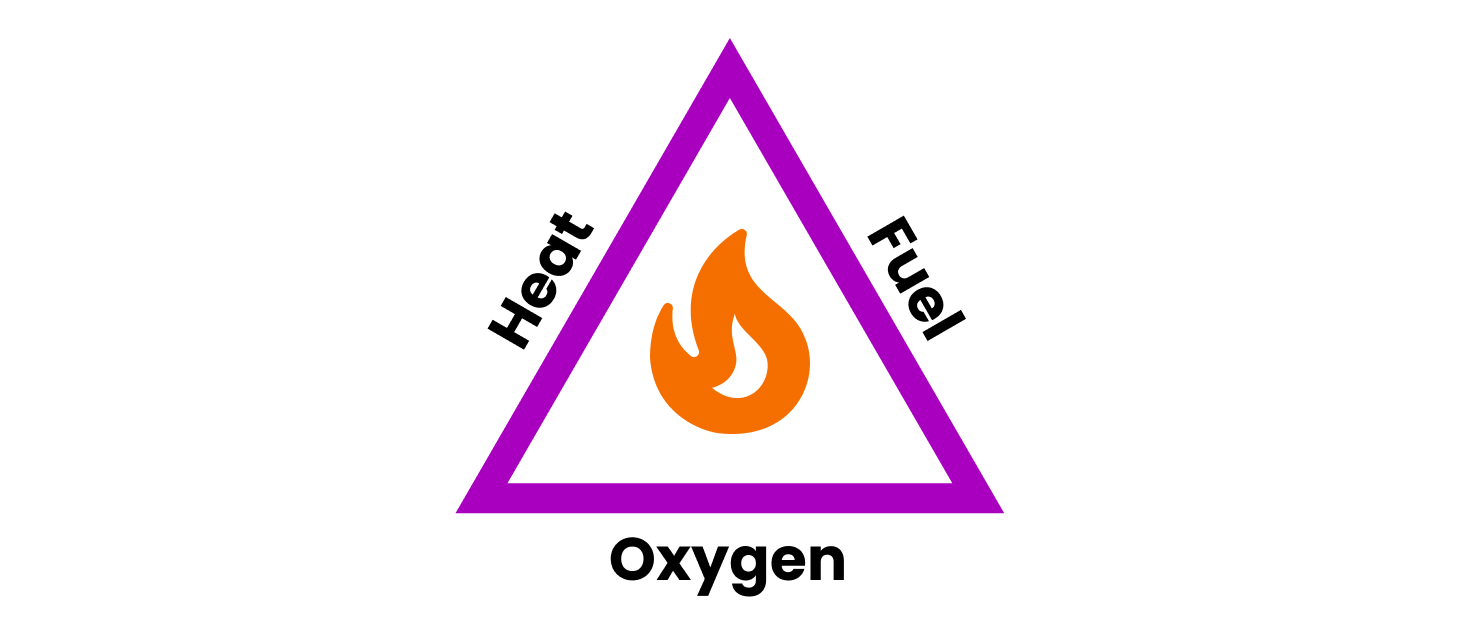
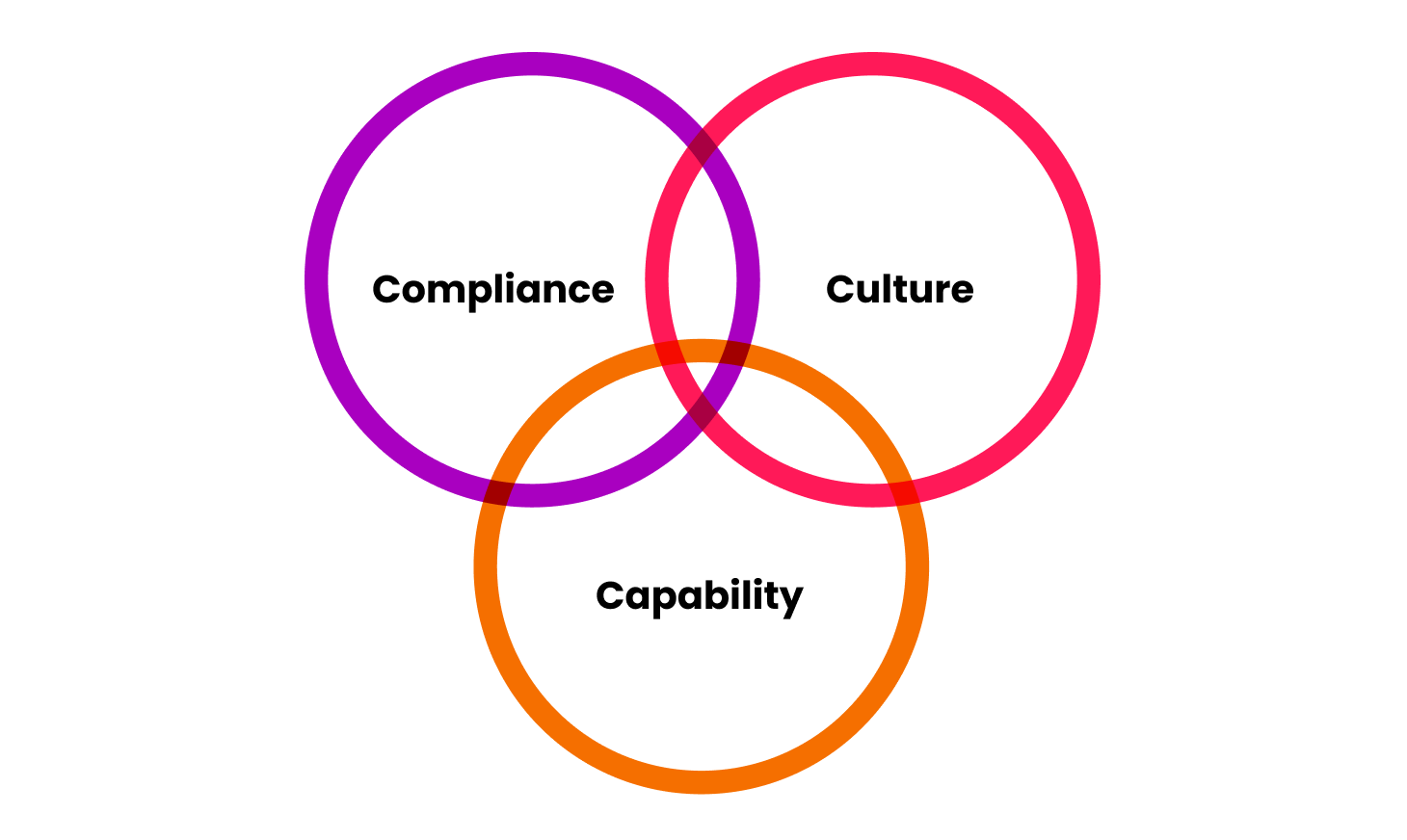
Sustainable accessibility in a large organisation can be modelled in the same way. We need to focus on three pillars to maintain momentum: compliance, culture, and capability. If any of these three are missing for a sustained period of time, the programme becomes unsustainable, and the organisation's ability to consistently deliver accessible products, like the fire, will burn out and stop.
Compliance
When we talk about compliance, we're talking about the laws, standards and governance which make sure your products meet a certain set of accessibility requirements. For example, checking your products against a defined standard or law, such as the Web Content Accessibility Guidelines (WCAG) 2.2, EN 301 549, the Public Sector Bodies Accessibility Regulations 2018, or the European Accessibility Act. It can also include your organisation's internal standards and policies.
Complying with standards is important. Without them, you have no way of measuring how good or bad something is. By using standards, you're always measuring against the same set of criteria, so it's easy to get the baseline data for where you are now, and to demonstrate your progress towards compliance in the future.
However, on its own, compliance is not enough. If accessibility is treated purely as a governance checklist, you're expecting people to pass an exam without really teaching them the subject matter first. Or, without helping them to understand why the exam is even important. If people in your organisation don't have the right skills to do the work to the correct standards, or the culture in the organisation is bad and they don't see the point in doing it, then it's highly unlikely any of your products will be compliant.
Culture
When we talk about culture, we're talking about how accessibility is viewed and respected within the organisation. For example, do senior leaders treat accessibility as a core value, rather than a risk to be managed? And, do teams view accessibility as a genuine user need, rather than a list of non-functional requirements?
Culture is one of the most important parts of accessibility, because it's the human element of human-centred design. A passion for accessibility can be infectious. Quite often, it's only a handful of people in an organisation who start a movement. If a small group makes enough noise about accessibility, it starts to get noticed.
When the culture in an organisation is good, you'll often see things emerging organically, like communities of practice, accessibility champions, accessibility principles, and conferences or events with a focus on accessibility. If you get the culture right, and people are motivated to do the work, even when nobody is watching, then implementing the capability and compliance parts of the strategy becomes a lot easier.
If the culture in an organisation is bad, and people feel unempowered or unable to influence it in a positive way, that passion and enthusiasm often turns into frustration, and it's likely that the only people that actually cared about accessibility in your organisation, will leave.
Culture change is hard, and it can require a lot of change management in large organisations. For example, you may need to make changes to things like employee incentives. If your incentives discourage people from focusing on accessibility, then that's the scenario that will play out. It's not uncommon for large organisations to reward quantity over quality when it comes to shipping features. And, if people are more likely to get a bonus, a promotion, or a better reputation by shipping inaccessible features quickly, that's exactly what they'll do. So it's important to look at people's motivations and incentives, and make sure they're aligned to your strategy.
Building a culture of accessibility is very rewarding, but again, on its own, it's not enough. People can care deeply about accessibility, and they can advocate loudly for people with disabilities, but if they don't have the right skills, tools, processes or guidance to act on it, then it's still highly unlikely you'll have any compliant products.
Capability
When we talk about capability, we're talking about making sure teams have the right knowledge, skills, tools, processes and guidance to deliver accessible products themselves. It's things like documentation, training, testing procedures and access to tools, like assistive technologies.
The capability pillar of the strategy often involves a lot of change management too. Take recruitment for example, things like onboarding processes, and adjusting job specifications to reflect each role's responsibility for accessibility. Making sure the people in those roles understand the changes, are trained accordingly, and that there is support in place to make sure the transition is a positive experience. Because, contrary to popular belief, accessibility is not just a job for designers and developers. Whether you're a Business Analyst gathering requirements, or you're a Product Manager creating a vision, every role has a responsibility in making sure accessibility happens.
Again, like the other two pillars, capability alone isn't enough. You can train everyone in the organisation and provide them with tools, but if the culture is bad, and nobody thinks accessibility matters, or there are no compliance measures holding anyone accountable, those new shiny skills and tools won't get used.
The three C's only work when you use all three pillars together. Compliance tells you where you are and what you're aiming at. Culture makes people passionate and motivated to do the work. Capability gives them the knowledge, skills and tools to be able to actually do it.
The strategy works
This isn't just a theoretical model. We've used it ourselves and seen it work in several large organisations.
It's the strategy used by the Department for Work and Pensions (DWP), one of the largest government departments in the UK. They have more than 80,000 employees, and their services are used by millions of people every day.
Since implementing the three C's, the department has buy-in and full support from senior leadership, they've created Accessibility Specialists roles and been recruiting for several years, established a Digital Accessibility Policy, and they provide guidance, tools and training to their delivery teams.
Since I joined TetraLogical, we've been using the same model in our consultancy service. We've recently used it to shape the accessibility strategy for a global supply chain business in the private sector, operating across dozens of countries.
We can't talk about the work in detail, but the engagement surfaced the same common issues. A very large organisation with operations across Europe and the rest of the world, suddenly facing the European Accessibility Act, and not really understanding what they needed to do. They had distributed teams, third-party suppliers, and despite their best efforts, had a history of shipping inaccessible products.
We started by assessing the organisation's maturity against the three C's. Then, through gap analysis, we were able to show them exactly where their problems and opportunities were. We helped them to understand where they could have the most impact, in the shortest amount of time.
As part of this work, we helped them to create a shared vision and a sustainable accessibility roadmap which targeted high impact initiatives, rather than them pouring all of their budget into once-and-done assessments. And, we worked closely with their change managers and senior leaders to implement the strategy from the top down.
Finally, because the three C's strategy is open sourced, we've also seen other people implement it in other organisations. Karl Goldstraw implemented the three C's at Hargreaves Lansdown, a large UK financial services company, which was Financial Times Stock Exchange (FTSE) listed at the time. It was actually Karl's team who came up with the name "the three C's", as in the original strategy, I had called it compliance, culture and education. A perfect example of why making things open makes things better.
As you can see from these case studies, we shouldn't just think of the three C's as a public or private sector model. It's an organisational model. It's proven to work for public services, commercial services and financial services. And, if your organisation is large enough to need governance, it's large enough to need a strategy that goes beyond it!
Where to start
If you're looking at accessibility in your organisation, we recommend starting with a simple exercise.
Take whatever accessibility work and assets you can find in your organisation, and try to group each of them using the three pillars. Ask yourself, is this contributing to compliance, culture, or capability? Then, look at the balance. If most things are grouped under just one or two pillars, this is a red flag. You're not contributing to all three sides of the triangle, and your fire will burn out.
For accessibility work to be sustainable, you'll need a good balance of initiatives and assets across all three pillars. So, if you're light on one or more, then you need to start figuring out what things you're missing, and start figuring out which things will have the most impact in the shortest amount of time.
Further resources
If you want to dig deeper into the challenges of scaling accessibility in large organisations, you can read the following:
- Strategic foundations in complex organisations
- Organisational realities in complex organisations
- External factors in complex organisations
Next steps
If you want to read more about accessibility governance, read: Is your board getting accessibility governance right?, or learn more about how our Consultancy service can help you embed accessibility within your organisation.